
Research Details
- What shapes the human heart?
- Gisborne, NZ
- Dr William Peters
- w.peters@matai.org.nz
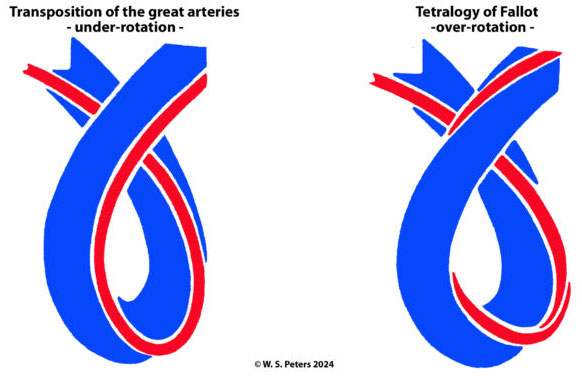
Perturbations during the cardiogenesis window can lead to devastating congenital heart diseases. Complex congenital malformations with distinctive truncal outflow topologies, such as Tetralogy of Fallot (ToF) and Transposition of the Great Arteries (TGA) must take shape in the cardiogenic window. There is no strong genetic association to explain these phenomena. The blood-based model allows the derivation of these complex syndromes as a result of relative over or under-rotation of the nascent oxygenated stream.
In ToF, a relatively larger/stronger over-rotated nascent oxygenated stream leads to a larger, dorsally rotated ascending aorta that overrides the ventricular septum and induces narrowing in the developing pulmonary trunk as the two loops scissor apart.
In TGA, an under-rotated red thread runs parallel out of the truncus and the two loops ‘boomarang’ apart; blue into upper arches (systemic, 3rd and 4th arches) and red into lower (pulmonary, 6th arches, leading to a parallel ventricular septum and two parallel loops rather than two loops in series.