
Research Details
- What shapes the human heart?
- Gisborne, NZ
- Dr William Peters
- w.peters@matai.org.nz
It is theorised that the magnetic susceptibility of circulating heme, which switches polarity with oxidation state, influences vertebrate evo-morphology and cardiogenesis.
Introduction
The closed, one-way circulation of blood is common to all vertebrates. The cardioscience project at Mātai starts with observations made of this closed-looped circulation and the polarity-switching nature of heme (in the red blood cell).
In fish, blood loops through the single ventricle heart, then through the gills where it is oxygenated before passing passively to the body via the dorsal aortae. In humans, mammals and birds, the heart is double-looped; blood loops through the right ventricle to the lungs (which have replaced the gills), and oxygenated blood returns to the heart to be re-accelerated via the second loop (left ventricle) to then perfuse the body. Salamanders and reptiles fall in between, possessing a mixed circulation that includes both gills and lungs.
The primary question that concerns the cardioscience project at Mātai is:
If mammals and birds evolved from fish via a reptilian transition, how did a double-loop heart evolve from a single loop, and how did gills become lungs?
Secondary questions arise, such as:
- Is bipedalism a function of geomagnetic precession of the closed blood circuit as the angle of moment changes with transition from a single to double-looped circuit?
- Why do humans and mammals have a left-sided aortic arch, while birds have a right-sided arch and does arch side selection influence distribution of somitomeric blood and thus body part growth?
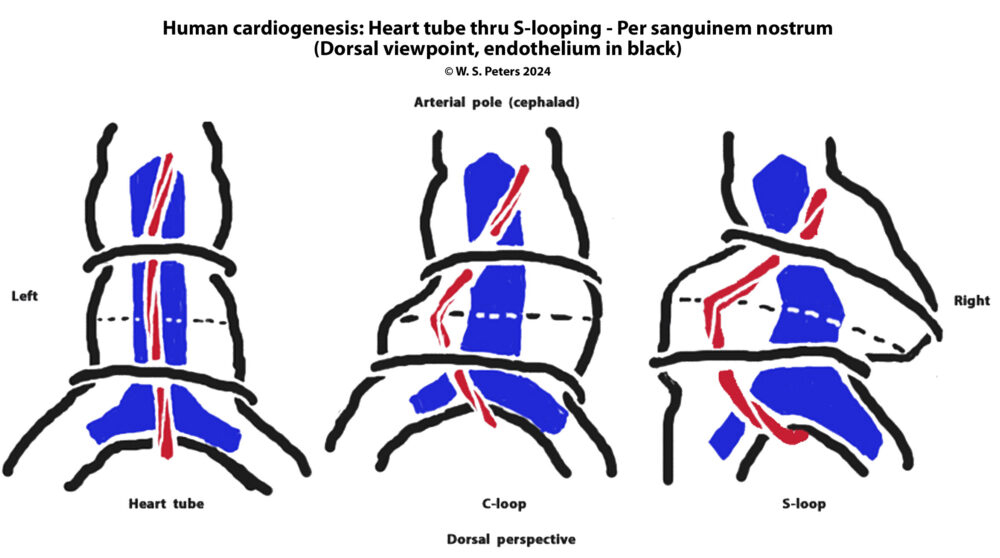
- Do microfluidic interactions between oxygenated and deoxygenated blood streaming in the embryonic heart tube influence cardiogenesis and complex congenital heart diseases?
Research opportunities
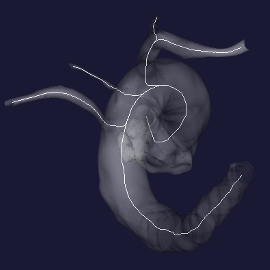 This project intends to develop geometric, electromotive models that capture this loop-in-loop circuit morphometry. Using MRI to extract 3D arterial distribution patterns from various vertebrate models, we seek to investigate any relationship between the development of left ventriculo-aortic spirality and relative somitomeric distribution, and to elucidate the advantages and disadvantages different topologies and environmental scenarios may impose on adaptability to the environment, and vice versa.