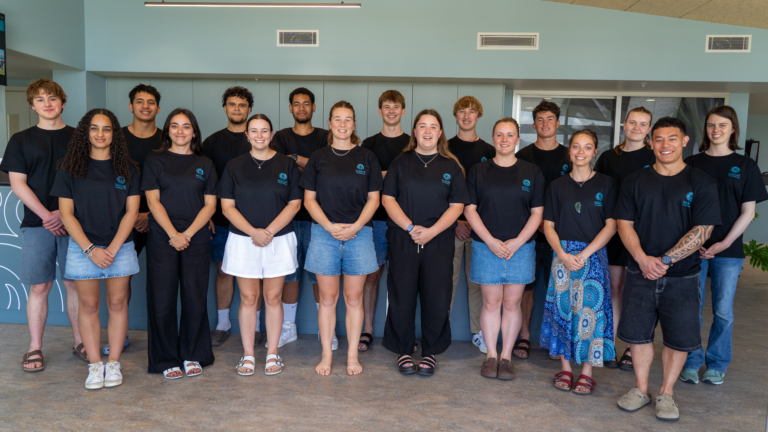
Above: Back row (from left): Harry Naske, Brayden Maxwell, Tupuhi Gardner, Tevita ‘Akau’ola, Luke Stoltenberg, Samuel Porter, Nic Proffit, Keeley Cairns, Holly Flyger Front row (from left): Ella Arthur, Hayley Templer, Rachael McLanachan, Holly Williams, Anna Heikell, Imogen Amor Bendall, Alani McLeod, Braden Fowell (Junior Project Coordinator).

2024/25 Internships

In the summer of 2024/25, Mātai was able to offer local summer internships to 16 students

From cutting-edge medical imaging to bioengineering, leadership, innovative research, and mātauranga Māori, our Mātai Summer Internship Programme gave 16 outstanding interns the chance to tackle real-world health challenges.

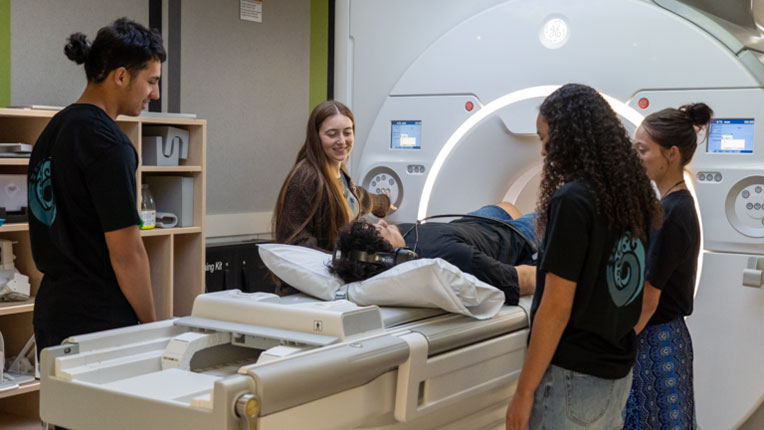
The interns explored a range of topics, including research methods, scientific training, leadership, and mātauranga Māori. Interns were guided by 23 supervisors and speakers across academia, healthcare, community, and industry – interns worked in a number of areas, including brain research, AI-driven diagnostics, and community-centred healthcare solutions.

This year, Mātai was proud to have ANZ Aotearoa as a major supporter of the programme, reinforcing their commitment to strengthening community resilience. Other major supporters include Hugh Green Foundation (cornerstone funder), Trust Tairāwhiti, QUEST Trust, Turanga Health, and Pultron Composites Ltd.

Mātai CE & research director Dr Samantha Holdsworth said the intern programme was an important part of Mātai, allowing students engaged in tertiary education to carry out research with the support and input of the Mātai team and collaborators.

Many students left the programme feeling inspired to return home in the future, eager to give back to their community.

Here is a glimpse of the students and the projects they worked on in this year’s programme.
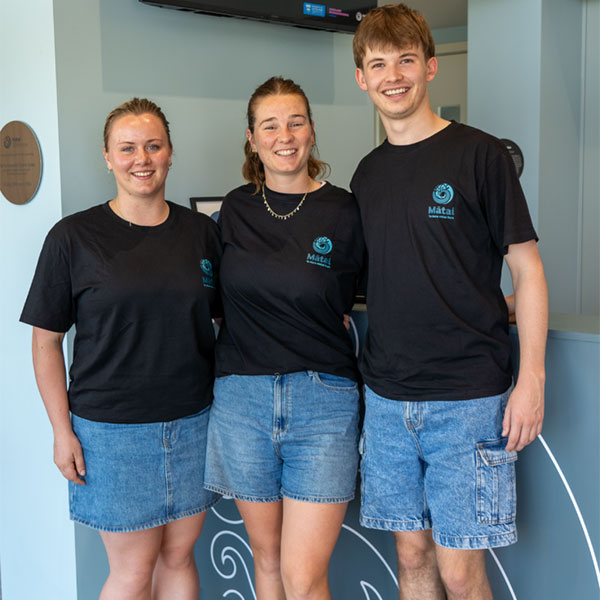
University of Canterbury Electrical and Electronic Engineering (2nd Year)

Luke Stoltenberg

Former Gisborne Boys’ High School Head Prefect

Luke explored the effects of noise (caused by low signal strength or interference, which can make images blurry or unclear – similar to static on a radio) on a cutting-edge MRI technique called Quantitative Amplified MRI (q-aMRI). The method, developed by Mātai and collaborators, is used to detect subtle brain motion. Luke’s goal was to assess how well it performs under noisy conditions, to ensure reliability when applied to brain images.

University of Canterbury, Bachelor of Mechanical Engineering (HONS) (2nd Year)

Alani McLeod

Former Gisborne Girls’ High School Head Prefect

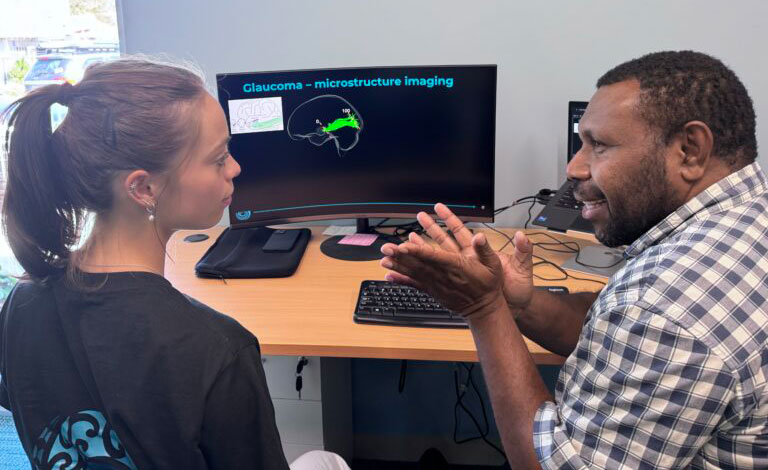
Alani’s project aims to develop a non-invasive method to detect glaucoma. This is done by using advanced diffusion MRI technique to study specific brain fibre tract (brain wiring) in the visual pathway and find potential biomarkers. Alani is pictured to the right with her project supervisor, Dr Loxlan Kasa, Mātai Research Fellow.

University of Otago, Physiotherapy (2nd Year)

Anna Heikell

Campion College

Anna conducted a literature review on the interface of MRI and physiotherapy in New Zealand, identifying barriers and future opportunities for integrating MRI in physiotherapy practice.

University of Otago, Neuroscience (3rd Year)

Imogen Amor Bendall

Campion College

Many people with a Traumatic Brain Injury (TBI) carry on experiencing ongoing effects of their injury, which we believe can often be discredited. This project aims to create a hierarchy of symptoms after TBI, to improve the understanding of the presentation of TBI symptoms and open areas for further research.

University of Otago, Dentistry (5th Year)

Nic Proffit

Gisborne Boys’ High School

Nic’s project was on “Pushing the Limits of Bone Imaging: UTE Acquisition and 3D printing of Teeth and Skull”. He explored various MRI techniques for dental imaging. The aim was to explore the novel application of MRI in dental imaging.

Victoria University of Wellington, Psychology (2nd Year)

Hayley Templer

Gisborne Girls’ High School

Hayley worked on the Tairāwhiti Child Well-being study. This project focuses on creating a normative database that can be applied to a diverse range of children using advanced MRI, through a community-led, culturally grounded and inclusive approach.

During Hayley’s time on the Tairāwhiti Child Well-being study, she produced a range of different materials for tamariki to engage with, to learn about MRI, and become more comfortable with the machine. She also helped by upholding the projects focus to create a normative database that can be applied to a diverse range of tamariki using advanced MRI, through a community-led culturally grounded and inclusive approach.

University of Canterbury, Engineering (Hons)

Harry Naske

Gisborne Boys’ High School

Harry’s research examined how methamphetamine use affects brain movement and if these movements return to normal after prolonged abstinence using advanced brain imaging techniques. While, uncovering potential recovery patterns through brain imaging. This research could shed new light on the effect of meth use on the brain, and help better understanding of brain recovery.

University of Otago, Dentistry (2nd Year)

Ella Arthur

Campion College

Ella’s study aimed to analyse heart MRI scans from individuals with methamphetamine addiction and healthy controls to assess differences in cardiac health between these groups. The objective was to identify trends, and provide insights into the long-term effects of methamphetamine addiction on heart health and investigate the signs of recovery in individuals in their abstinence journey.

University of Otago, Anatomy (4th Year)

Rachael McLanachan

Gisborne Girls’ High School

Rachael analysed volume differences in the substantia nigra (a part of the brain that helps control movement by producing dopamine) in methamphetamine users to determine differences that could contribute to our understanding of addiction-related brain changes.

University of Canterbury, Psychology (5th Year)

Holly Williams

Gisborne Girls’ High School, St Peter’s Cambridge

This project, led by Professor Holly Thorpe, aims to capture the voices of Rangatahi from flood-affected Tairāwhiti Gisborne. It explores how local youth have been impacted by recent extreme weather events, the effects on their families and community, and their hopes and concerns for the future.

University of Auckland, Biomedical Science (2nd Year)

Brayden Maxwell

Gisborne Boys’ High School

Brain-RePAIR focused on brain recovery in adolescents using imaging after a rugby season. The goal of this study is to explore brain recovery processes to inform improved stand-down periods and return-to-play protocols.

Brayden’s second project involved analysing user responses to VR-based ‘Brainwatch’, specifically from local adolescent students who used a VR brain interface. The analysis compared pre- and post-interaction responses to create clear, visually engaging data plots, illustrating the effectiveness of VR as an educational tool.

University of Auckland, Computer Science (3rd Year)

Tupuhi Gardner

TKKM o Ngā Uri a Maui, Gisborne Boys’ High School

Tupuhi worked on a project led by Rongowhakaata Iwi Trust CEO Teina Moetara to investigate the connection between vitality and the functionality of brain networks, using MRI scans. Vitality in this study refers to a person’s connection to their personal identity as tangata whenua (traditional custodians of the land), as well as their connection to place. Tupuhi also played a pivotal role in mātauranga Māori at Mātai, by leading a mihi whakatau, hosting visitors, and being a role model for all.

University of Auckland, Software Engineering (2nd Year)

Tevita ‘Akau’ola

Gisborne Boys’ High School

In long-term MRI studies, a common challenge is the inconsistency of measurements across scans. This project aims to determine the extent of variability in various MRI sequences that can still be considered normal. It involves learning the process of recruiting participants for scans and developing code to extract and analyse brain measurements.

Victoria University of Wellington, Biomedical Science (2nd Year)

Keeley Cairns

Gisborne Girls’ High School

Keeley is conducting a systematic review to investigate the genetics of traumatic brain injury (TBI) recovery and comparing it to genetic predispositions for brain disease. This involves identifying relevant genes and variants associated with recovery outcomes after TBI and understanding how baseline genetic factors contribute to recovery variability. This could help unlock new insights into brain health.

University of Canterbury, Mechanical Engineering (2nd Year)

Samuel Porter

Samuel’s research focused on developing a deep-learning algorithm to automate white matter segmentation in Ultra-High Contrast MRI, enhancing brain disorder assessments. The aim was to achieve highly accurate segmentation, to enhance the potential of the new imaging technique, ultimately, to enable better review of brain disorders.

University of Auckland, Biomedical Engineering (3rd Year)

Holly Flyger

Holly Flyger, a Mātai Scholarship recipient, returns for her second internship after an impressive first year. At just 19 years old, the former Gisborne Girls’ High School student had a paper she worked on published in the prestigious Journal of Neural Regeneration Research. This is an extraordinary accomplishment, as many researchers spend years in their academic careers before reaching this stage, making Holly’s success even more notable.

This year, Holly’s research focused on how a person’s movement in the MRI scanner affects videos acquired through advanced MRI techniques, including aMRI and q-aMRI.