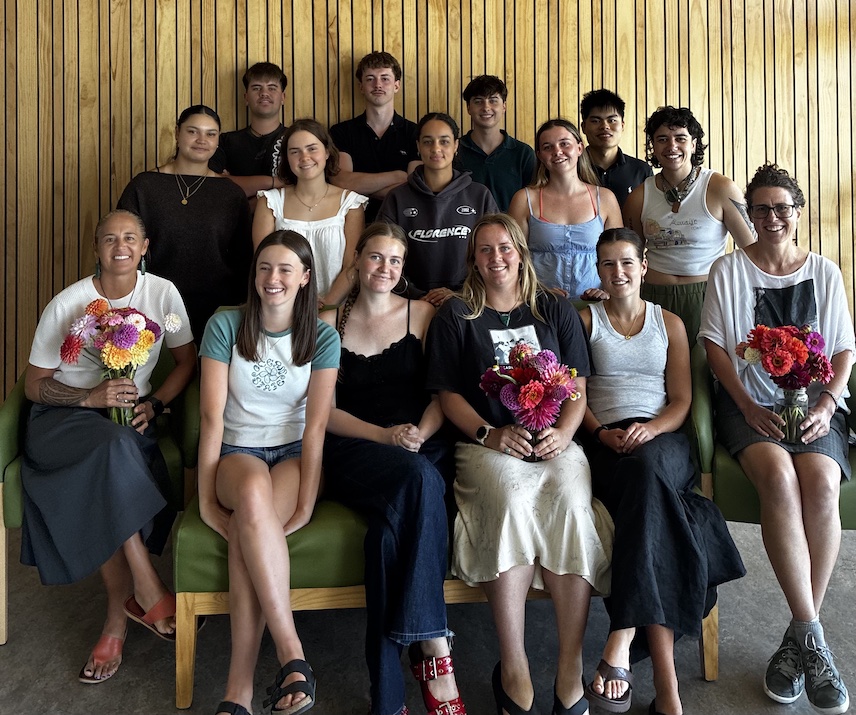
Back Left to Right: Ned Clarke, Noah Mason, Nicholas Kane, Mathew Sung
Middle Left to Right: Cheidan Moetara, Frankie Muir, Ella Arthur, Miah Somerton, Paris Riria Maxwell
From Left to Right: Leigh Potter (COO, Mātai), Naiya Powley, Keeley Cairns, Imogen Amor-Bendall, Tui Cave, Samantha Holdsworth (Associate Professor University of Auckland and CE/Research Director Mātai)
Absent: Ky Bartlett, Jamila Fleming
2025 interns make meaningful contributions to research
This year’s Mātai summer interns made meaningful contributions to a range of important scientific research projects over a 10-week period during the summer holidays. Alongside their research, interns participated in a comprehensive learning programme that included sessions on how MRI works, research methods, mātauranga Māori, neuropsychiatry, statistics, and leadership development. Guest speakers shared insights on topics such as Kaupapa Māori biomedical research, career pathways, research and commercialisation, the inclusion of neurodevelopmentally and behaviourally complex children in medical research, artificial intelligence, and genetics and molecular biology and more. The programme also offered opportunities for community engagement and wellbeing activities, including with iwi health through Tūranga Health and Manawaru; waiata at Gisborne Hospital; sports days; and hands-on experiences such as robotics with Tōnui Collab.
The 2025-2026 internships were made possible through the generous support of the Hugh Green Foundation, Centre for Brain Research and FMHS – University of Auckland, Freemasons Foundation, Gisborne Host Lions Club and Gisborne Wainui Lions Club, Health Research Council, JN & HB Williams Foundation, Kānoa – Regional Economic Development & Investment Unit, Mangatawa Beale Williams Memorial Trust, Pultron Composites, QUEST Enterprise Trust, Rapanui Trust, Royal Society Te Apārangi – Hawke’s Bay Branch, Tindall Foundation, Trust Tairāwhiti, Tūranga Health, University of Canterbury, and the Woolf Fisher Trust.
Meet the students
Ella Arthur (Ngāi Te Rangi) is a Bachelor of Dental Surgery student at the University of Otago. Her research explores non-traumatic dental presentations to Tairāwhiti Hospital’s Emergency Department, examining who is seeking urgent dental care and why. “I want to better understand the barriers people face in accessing dental care,” says Ella. “If we can identify where inequities exist, we can start to improve pathways so people receive timely, appropriate care, rather than ending up in emergency departments.”
Naiya Powley has just completed her first year of Physiotherapy at Auckland University of Technology (AUT). Her project focuses on developing a system that links real-time oxygen and carbon dioxide measurements with MRI scans. This work supports studies investigating how the brain responds to changes in blood gases, helping to improve understanding of vascular function in both healthy individuals and people living with conditions such as stroke or sleep apnoea.
Nicholas Kane has recently completed his Bachelor of Biomedical Science at the University of Auckland. His research examined how alcohol use, smoking, illicit substance use, and gambling addiction may be associated with visual dysfunction. By reviewing existing literature, Nicholas helped identify gaps in current knowledge and highlighted areas requiring further investigation. Addiction, in its many forms, is highly prevalent in the Tairāwhiti region, and by identifying overlooked health impacts related to addiction, this research has the potential to contribute to improved health outcomes for the local community.
Paris Riria Maxwell (Ngāti Rangiwewehi, Ngāti Tūwharetoa, Te Aitanga-a-Mahaki) will undertake a Bachelor of Commercial Music at Toi Ohomai/Massey University, minoring in Philosophy. Their project focused on the occipital lobe (the area at the back of the brain responsible for processing vision), and the white matter tracts (communication pathways connecting different parts of the brain). Paris aimed to understand whether long-term methamphetamine use may damage or alter these pathways, potentially affecting how visual information is processed. Identifying these changes, could help us understand how drug use impacts brain health, and how those effects might be detected, understood, or addressed earlier.
Noah Mason completed a Bachelor of Science in Biomedical Science at the University of Auckland in 2025. His research explored whether measuring how brain tissue deforms (known as strain), rather than only how it moves, can better detect differences in brain health using Mātai amplified MRI (aMRI) technology. The project aimed to determine whether strain-based measures could more clearly distinguish between different groups, such as people living with dementia and healthy control participants.
Miah Somerton (Te Ātiawa, Ngāti Oneone) is a physiotherapy student at Auckland University of Technology (AUT). Her project explored Māori perspectives on research data use, contributing to the strengthening of Māori data sovereignty at Mātai. “Being part of a programme so deeply connected to the Tairāwhiti community has been incredibly grounding,” she says. “It’s shown me how research can be done in a way that respects people, culture, and data as taonga.”
Imogen Amor-Bendall has recently completed her undergraduate degree in Neuroscience at the University of Otago and contributed to the Methamphetamine Recovery Study at Mātai, with a focus on heart health measures.
Jamila Fleming (Ngāti Porou, Ngāti Kahungunu) recently graduated with a Bachelor of Psychological Science from the University of Canterbury, with a minor in Māori and Indigenous Studies and Psychological Wellbeing. Her research used advanced MRI techniques to investigate whether changes in blood supply and how evenly it is distributed could help improve understanding of how Parkinson’s affects brain function.
Keeley Cairns has completed a Bachelor of Biomedical Science, majoring in Human Genetics and Molecular Pathology, at Victoria University of Wellington, and will begin a clinically focused Master’s programme in 2026. Over the summer, she has contributed to early feasibility work for a clinical research project aimed at improving support and health outcomes for people living with type 2 diabetes or pre-diabetes.
Ky Tauiru Bartlett (Ngāti Porou) completed his first year of a Bachelor of Science at the University of Auckland, majoring in Exercise Science, and hopes to pursue a career in physiotherapy. Over the summer, Ky worked on a project which explored whether measurements of brain motion and blood flow remain consistent when heart rate varies in a controlled way. This research could help us understand how physical activity can benefit not only physical wellbeing, but cognitive health as well.
Ned Clarke (Ngāti Porou, Ngāpuhi, Rongowhakaata) and Tui Cave (Rongowhakaata) worked on developing quantitative approaches to analysing ultra-high contrast MRI (UHC-MRI) brain scans. Ned completed his first year of a Bachelor of Science at the University of Auckland and is moving into Medical Imaging.
Tui is an Engineering (Honours) student at the University of Canterbury specialising in Chemical and Process Engineering. Their work contributes to an imaging method being developed at Mātai that may enable earlier and more reliable detection of brain conditions such as multiple sclerosis, Alzheimer’s disease, stroke, and brain tumours.
Cheidan Moetara (Rongowhakaata, Tapuika) has completed her first year at the University of Auckland, studying a Certificate in Health Sciences. Over the summer, she contributed to the Tairāwhiti Child Wellbeing Study, which aims to better understand what “normal” health looks like for tamariki. She hopes this mahi will support earlier intervention and more effective, community-led approaches to improving child wellbeing in the region.
Mātai Chief Operating Officer Leigh Potter says the internship programme reflects our commitment to building local capability. “By investing in local talent, supporting students to return home, and aligning research with the aspirations of our communities, Mātai continues to build a pipeline of future clinicians, researchers, and innovators committed to advancing health outcomes for Tairāwhiti and beyond.”
The internship learning programme was led and coordinated by Hugh and Moira Green Senior Research Fellow Dr Maryam Tayebi who oversaw delivery of the educational and professional development components across the summer.